
With SpaceX, Anthropic, and OpenAI preparing to IPO, is a “two-speed” economy emerging?


With SpaceX, Anthropic, and OpenAI preparing to IPO, is a “two-speed” economy emerging?
The world’s leading companies spent the past two decades going asset-light. Capital allocation trended away from hard assets — oil rigs, machinery, equipment — and toward buybacks, dividends, and the flexibility that knowledge-based businesses allow. Then AI arrived and reversed that trend.
Over the past two years, the world’s largest technology firms have committed unprecedented sums to capital expenditure, primarily in data centers and chips. Hyperscalers are expected to spend more than $600 billion on AI-related CapEx in 2026 alone.[1] Among the “Magnificent 7,” CapEx has risen from roughly 19 percent of total uses of capital in 2023 to 28 percent in 2025, equivalent to over $450 billion in annual investment.[2]
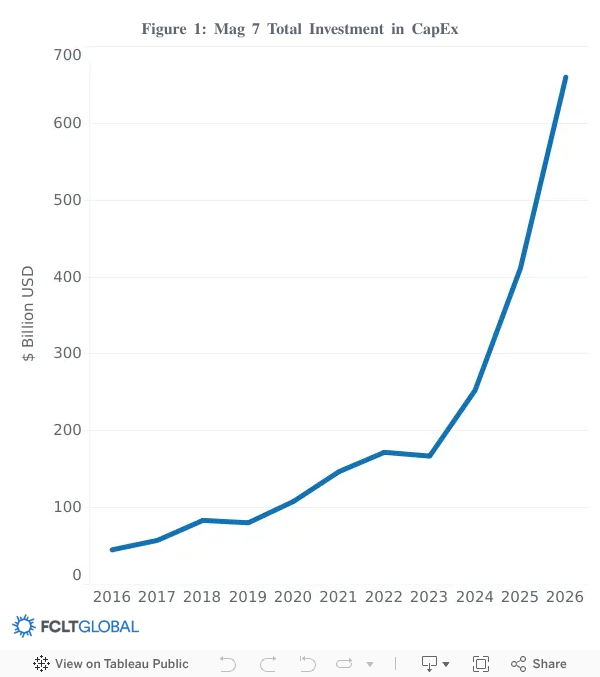
On the surface, this looks like a return to long-term thinking, as higher levels of fixed investment are one of the more significant indicators of long-term value creation. But this trend belies the reality that this shift is highly concentrated. For most companies, capital allocation has not materially changed. Buybacks and dividends remain dominant, and flexibility continues to be prized over commitment. And the economics of AI infrastructure make it likely to stay that way – unlike prior waves of digital investment, AI buildout is capital-intensive and scale-dependent. The firms that can deploy tens of billions upfront and sustain it are a very short list. Strip out the Magnificent 7, and investment horizons for the remaining companies in the MSCI ACWI decreased by 14 percent over the same period.
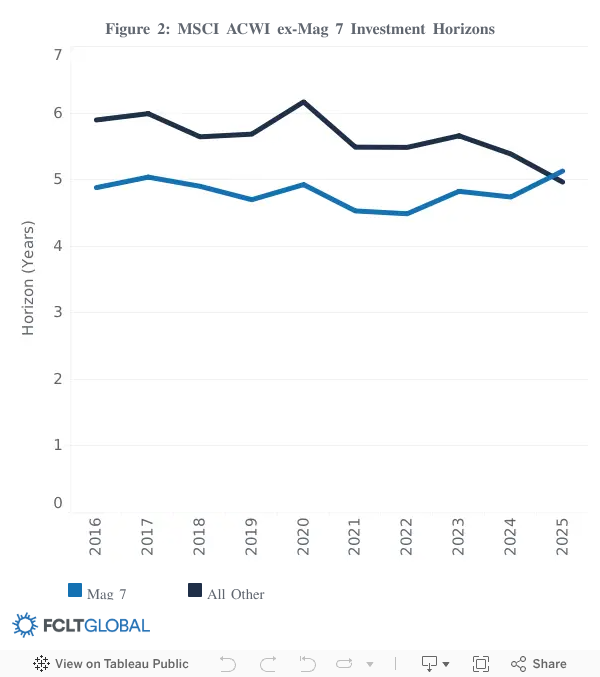
The result is a K-shaped time horizon – a two-speed economy in which a handful of firms are making increasingly long-duration bets while the broader market moves in the opposite direction. And now, with the pending introduction of SpaceX, OpenAI, and Anthropic to the public markets, the “Magnificent 7” may turn into a “Magnificent 10”, with 10 companies accounting for nearly 40% of the S&P 500’s market cap, more than triple their index weight from a decade ago. The long-term implication of this trend is that those companies in the “high-speed” economy will have a near insurmountable advantage – via earlier and larger investments in data centers, computational capacity, and proprietary models – over competitors, having built barriers to entry that smaller firms or startups cannot move past. The K-shape in capital allocation today may produce a K-shape in market structure later – where newcomers without significant resources are not able to disrupt a status quo dominated by an increasingly smaller number of increasingly larger firms.
On the surface, renewed capital expenditure signals a commitment to long-term investments and a healthy development for markets broadly. But because this shift is concentrated among such a narrow cohort of leading firms, the rest of the market runs a real risk of being left behind.
That divergence carries downstream consequences. As performance and capital gravitate toward a shrinking number of names, active managers — already contending with a market in which 86% underperform their 10-year benchmark — will hug the index more tightly rather than take undue risks.[3] The result is a feedback loop that further entrenches concentration, narrows the competitive landscape, and reduces the efficacy of capital markets over the long term.
Top hyperscalers set to boost 2026 AI spending by 70% to $600 billion, CNBC.
FCLTGlobal analysis of MSCI ACWI data from FactSet.

Innovation | Report
20 May 2026 - This report examines a central question: Do public markets actually reward sustained investment in innovation over the long term?

Governance | Report
13 April 2026 - This research, conducted in collaboration with MSCI Institute and leveraging data from MSCI Solutions, examines how director equity ownership shapes long-term outcomes across more than 2,100 global public companies. The findings are clear and consistent across markets: when directors — particularly independent directors — hold meaningful, sustained equity stakes, companies deliver stronger long-term performance.

Investor Risk and Responsibilities | Report
14 July 2025 - Climate change is a force reshaping the global economy—and will influence capital allocation for decades to come. Climate-related risks and externalities, especially carbon emissions, are becoming material to long-term financial decision-making.