Investment Horizons

Markets are most efficient when the investment horizons — the length of time a security, portfolio, or other asset is held — of savers, investment organizations, and companies are aligned. This chart assigns year-based horizons to each, allowing for a direct comparison between their investment and capital allocation outlooks.

The weighted averages of the intended timeframes required for investments to be recouped, come to fruition, or meet an end goal, based on various expenses or allocations, in years. Please read the latest FCLTCompass report to learn more about how we calculate specific investment horizons.

0
1
2
3
4
5
6
7
8
9
10
11
12
13
14
15
16
Expected Time Horizon in Years
2024
9
Households' horizon down 10% from 2023, down 40% from 2014.
5.67
Institutional Investors' horizon up 5% from 2023, up 8% from 2014.
5.5
Asset classes' horizon up 10% from 2023, up 8% from 2014.
5.25
Public companies' horizon down 5% from 2023, down 15% from 2014.
2023
10
Households' horizon down 12% from 2022, down 33% from 2013.
5.42
Institutional Investors' horizon down 1% from 2022, up 5% from 2013.
5
Asset classes' horizon down 8% from 2022, up 2% from 2013.
5.5
Public companies' horizon up 3% from 2022, down 14% from 2013.
2022
11.33
Households' horizon down 6% from 2021, down 25% from 2012.
5.5
Institutional Investors' horizon up 1% from 2021, up 8% from 2012.
5.45
Asset classes' horizon up 4% from 2021, up 5% from 2012.
5.33
Public companies' horizon up 0% from 2021, down 20% from 2012.
2021
12
Households' horizon down 14% from 2020, down 20% from 2011.
5.42
Institutional Investors' horizon up 5% from 2020, up 8% from 2011.
5.25
Asset classes' horizon down 2% from 2020, down 2% from 2011.
5.33
Public companies' horizon down 11% from 2020, down 14% from 2011.
2020
14
Households' horizon down 1% from 2019, down 9% from 2010.
5.17
Institutional Investors' horizon down 5% from 2019, up 13% from 2010.
5.33
Asset classes' horizon down 3% from 2019, up 10% from 2010.
6
Public companies' horizon up 8% from 2019, down 3% from 2010.
2019
14.08
Households' horizon down 2% from 2018, down 9% from 2009.
5.42
Institutional Investors' horizon up 3% from 2018, up 28% from 2009.
5.5
Asset classes' horizon up 10% from 2018, up 18% from 2009.
5.58
Public companies' horizon up 0% from 2018, down 14% from 2009.
2018
14.42
5.25
5
5.58
2017
13.75
5.5
5.33
5.92
2016
14.38
4.92
4.92
5.83
2015
14.75
5.25
5.08
6.08
2014
14.92
5.25
5.08
6.17
2013
14.92
5.17
4.92
6.42
2012
15.08
5.08
5.17
6.67
2011
15.08
5
5.33
6.17
2010
15.42
4.58
4.83
6.17
2009
15.42
4.25
4.67
6.5

Household Market Participation & Allocation

Market participation improves long-term financial stability. This chart indicates how households allocate their savings globally and how many are growing their savings via capital markets.

The percentage of households that invest some portion of their money in capital markets, and the percentages of total household savings allocated to cash, capital markets investments (e.g., equity, mutual funds, pensions, life insurance), or real estate measured on a national basis1,2,3,4.

% Market Participation by Household
  • Sweden

    65%

  • United States

    57%

  • Australia

    51%

  • Switzerland

    44%

  • Chile

    34%

  • Canada

    33%

  • France

    32%

  • Germany

    30%

  • Japan

    30%

  • Greater China

    26%

  • United Kingdom

    23%

  • Norway

    21%

  • Netherlands

    20%

  • New Zealand

    20%

  • Spain

    12%

  • Italy

    10%

  • Singapore

    8%

  • Indonesia

    7%

  • India

    3%

  • Turkey

    1%

  • Brazil

    1%

  • South Africa

    1%

  • Colombia

  • Egypt

  • Israel

  • Malaysia

  • Mexico

  • Peru

  • South Korea

  • United Arab Emirates

United Arab Emirates
Metric Allocation
Cash Allocation 21%
Capital Markets Allocation 36%
Real Estate Allocation 43%
Australia
Metric Allocation
Market Participation by Household 51%
Cash Allocation 9%
Capital Markets Allocation 30%
Real Estate Allocation 61%
Brazil
Metric Allocation
Market Participation by Household 1%
Cash Allocation 10%
Capital Markets Allocation 43%
Real Estate Allocation 47%
Canada
Metric Allocation
Market Participation by Household 33%
Cash Allocation 16%
Capital Markets Allocation 35%
Real Estate Allocation 49%
Switzerland
Metric Allocation
Market Participation by Household 44%
Cash Allocation 17%
Capital Markets Allocation 37%
Real Estate Allocation 46%
Chile
Metric Allocation
Market Participation by Household 34%
Cash Allocation 9%
Capital Markets Allocation 46%
Real Estate Allocation 45%
Greater China
Metric Allocation
Market Participation by Household 26%
Cash Allocation 36%
Capital Markets Allocation 9%
Real Estate Allocation 55%
Colombia
Metric Allocation
Cash Allocation 8%
Capital Markets Allocation 34%
Real Estate Allocation 58%
Germany
Metric Allocation
Market Participation by Household 30%
Cash Allocation 15%
Capital Markets Allocation 24%
Real Estate Allocation 61%
Egypt
Metric Allocation
Cash Allocation 25%
Capital Markets Allocation 12%
Real Estate Allocation 63%
Spain
Metric Allocation
Market Participation by Household 12%
Cash Allocation 12%
Capital Markets Allocation 19%
Real Estate Allocation 69%
France
Metric Allocation
Market Participation by Household 32%
Cash Allocation 12%
Capital Markets Allocation 25%
Real Estate Allocation 63%
United Kingdom
Metric Allocation
Market Participation by Household 23%
Cash Allocation 17%
Capital Markets Allocation 31%
Real Estate Allocation 52%
Indonesia
Metric Allocation
Market Participation by Household 7%
Cash Allocation 26%
Capital Markets Allocation 12%
Real Estate Allocation 62%
Israel
Metric Allocation
Cash Allocation 14%
Capital Markets Allocation 58%
Real Estate Allocation 28%
India
Metric Allocation
Market Participation by Household 3%
Cash Allocation 11%
Capital Markets Allocation 10%
Real Estate Allocation 79%
Italy
Metric Allocation
Market Participation by Household 10%
Cash Allocation 12%
Capital Markets Allocation 31%
Real Estate Allocation 57%
Japan
Metric Allocation
Market Participation by Household 30%
Cash Allocation 34%
Capital Markets Allocation 26%
Real Estate Allocation 40%
South Korea
Metric Allocation
Cash Allocation 22%
Capital Markets Allocation 12%
Real Estate Allocation 66%
Malaysia
Metric Allocation
Cash Allocation 10%
Capital Markets Allocation 21%
Real Estate Allocation 69%
Mexico
Metric Allocation
Cash Allocation 7%
Capital Markets Allocation 26%
Real Estate Allocation 67%
Netherlands
Metric Allocation
Market Participation by Household 20%
Cash Allocation 10%
Capital Markets Allocation 38%
Real Estate Allocation 52%
New Zealand
Metric Allocation
Market Participation by Household 20%
Cash Allocation 8%
Capital Markets Allocation 43%
Real Estate Allocation 4%
Norway
Metric Allocation
Market Participation by Household 21%
Cash Allocation 8%
Capital Markets Allocation 22%
Real Estate Allocation 70%
Peru
Metric Allocation
Cash Allocation 9%
Capital Markets Allocation 39%
Real Estate Allocation 52%
Sweden
Metric Allocation
Market Participation by Household 65%
Cash Allocation 8%
Capital Markets Allocation 54%
Real Estate Allocation 38%
Singapore
Metric Allocation
Market Participation by Household 8%
Cash Allocation 19%
Capital Markets Allocation 37%
Real Estate Allocation 44%
Turkey
Metric Allocation
Market Participation by Household 1%
Cash Allocation 15%
Capital Markets Allocation 8%
Real Estate Allocation 77%
United States
Metric Allocation
Market Participation by Household 57%
Cash Allocation 8%
Capital Markets Allocation 60%
Real Estate Allocation 32%
South Africa
Metric Allocation
Market Participation by Household 1%
Cash Allocation 17%
Capital Markets Allocation 52%
Real Estate Allocation 31%

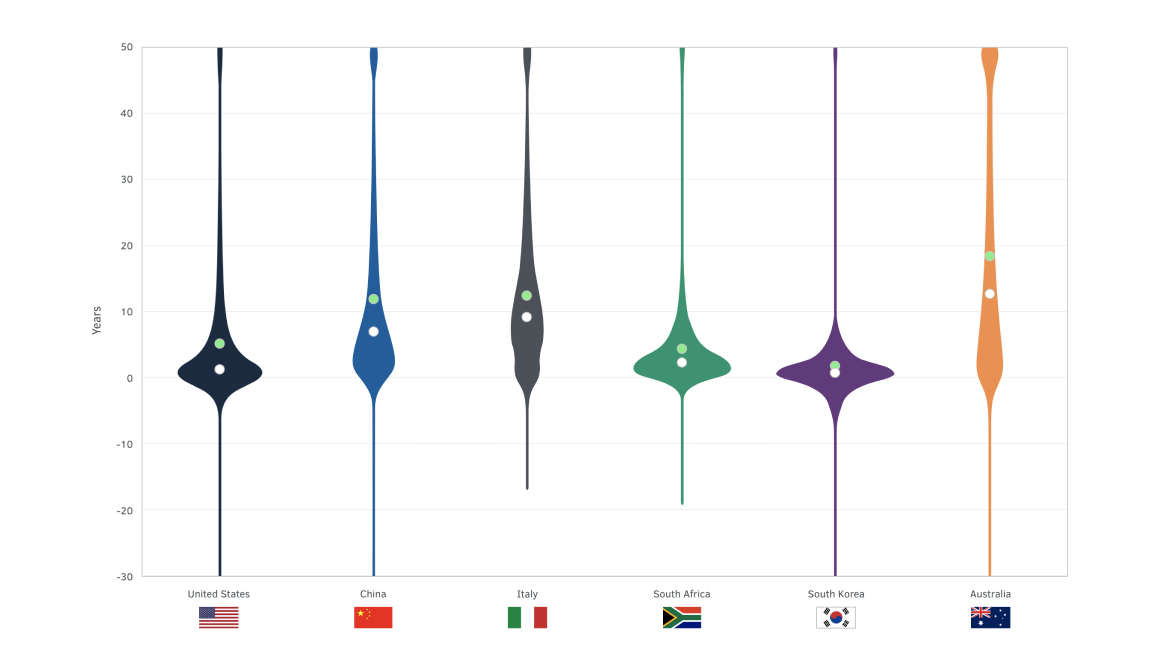
Household Retirement Savings

Millions of people worldwide are saving money to meet personal financial goals, namely funding a comfortable retirement. This chart indicates how long people in certain countries can live off their current savings5.

The number of years households in various countries can sustain themselves with their current net wealth given their current level of annual expenditures. The vertical axis represents the range of years households can sustain themselves; values below zero indicate households in debt. The horizontal axis indicates the concentration of households at a given year. Extreme values truncated at -30 and 50 for illustrative purposes.

Years

United States
China
Italy
South Africa
South Korea
Australia

1 “The Global Wealth Report 2024,” UBS group, 2024.

2 “The World Factbook,” CIA, accessed October 2024..

3 Household Financial Assets,” OECD, accessed July 2024.

4 See, e.g. “What drives stock market participation? The role of institutional, traditional, and behavioral factors — Wave 5.” For a complete list of capital market participation data, contact [email protected].

5 KLIPS, SHIW, HILDA, PSID, SCF, NIDS, CHFS

Innovation | Article

Is Corporate Investment Finally Funding the Future?

10 November 2021 - Corporate R&D spending increased significantly during the pandemic, setting the stage for a future boom in innovation and value creation. Is this a sign of the winners just pulling ahead of the rest?

Learn More

In the News

How the Pandemic Changed the Terms of Investment

7 December 2021 - Long- and short-term expectations aren’t what they used to be, from corporate decisions to the fidgets in equities. And you’ll need to rethink sovereign wealth funds.

Learn More

Risk and Resilience | Article

The Big Short: Investor Time Horizon Contraction in the Wake of Net Zero Commitments

24 November 2021 - Will shorter holding periods have an impact on climate change efforts?

Learn More