“The readiness to turn away from something that’s no longer productive and embrace something new is far more prescient here.”
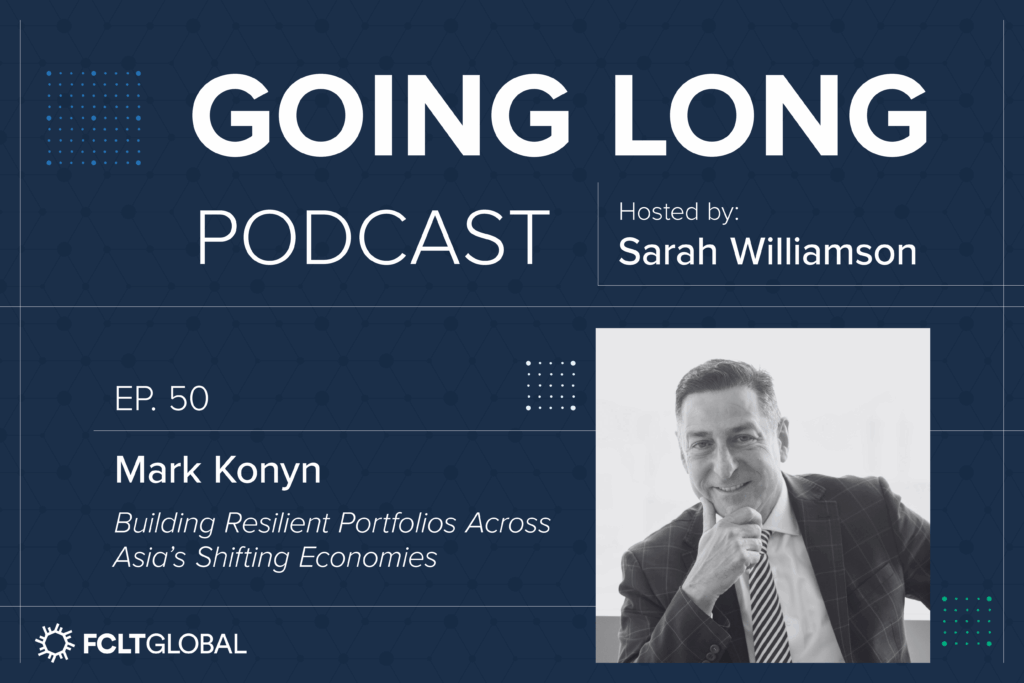
In this episode of the Going Long Podcast, Sarah Williamson speaks with Mark Konyn, Group Chief Investment Officer at AIA Group. Drawing on decades of experience across the region, Konyn explores Asia’s structural diversity, the role of long-term capital, China’s economic transition, and why technology adoption across Asia may reshape markets faster than many expect.
Topics Include:
- [00:00:00] Asia is not a single investment story
Konyn opens by challenging the idea of Asia as a homogeneous region, emphasizing the importance of understanding local legal systems, financial structures, demographics, and development paths. - [00:07:00] How long-term capital is mobilized in Asia
The role life insurers play in aggregating domestic savings, matching long-dated liabilities and assets, and supporting the development of capital markets and infrastructure. - [00:12:00] Hong Kong’s renewed role as a financial hub
What “Hong Kong is back” looks like on the ground, pointing to IPO activity, returning international engagement, and the city’s continued role as a conduit for capital. - [00:20:00] China’s structural transition and the confidence challenge
China’s property overhang, demographic shifts, and the way confidence, rather than capital availability, is shaping savings behavior and investment outcomes. - [00:46:00] Why technology adoption may surprise investors
Looking ahead, Konyn explains why Asia’s speed and willingness to adopt digital finance, automation, and AI could reshape markets over the next decade.
Asia as a multifaceted economic force
Asia is often described as though it were moving broadly in one direction and governed by the same structural forces. Konyn explains why that framing has outlived its usefulness. While several Asian economies shared common growth drivers during earlier phases of industrialization — including high savings rates, productivity gains, and heavy investment in education — those similarities mask increasingly divergent trajectories.
Konyn traces how historical shorthand hardened into habit. Early success stories encouraged investors to extrapolate a single “Asia growth model,” even as countries matured at different speeds and under different institutional constraints. Today, legal systems, demographic profiles, capital market depth, and regulatory regimes vary widely across the region. For long-term investors, treating Asia as a monolith risks mispricing both opportunity and risk. The challenge now is not identifying “Asia exposure,” but understanding which markets, structures, and timelines align with specific long-term objectives.
Long-term capital and the role of life insurers
Those distinctions become especially clear when examining how capital is formed and deployed. Konyn draws on the perspective of an insurer to explain how long-term capital operates differently from more transactional forms of investment. Life insurance pools household savings into long-dated liabilities, creating capital that can be matched to infrastructure, bond markets, and other long-duration assets essential to economic development.
This structure also shapes behavior. Regulatory frameworks across much of Asia encourage insurers to invest domestically, reinforcing the link between local savings and local growth. Over time, this anchoring effect helps deepen capital markets and supports investment horizons that extend well beyond typical market cycles. Konyn argues that this patient capital plays a stabilizing role — particularly in economies navigating demographic shifts or structural transitions — precisely because it is designed to think in decades rather than quarters.
Hong Kong as a financial connector
Hong Kong emerges in the conversation not as a relic of a previous era, but as an evolving financial intermediary. Konyn describes the city’s post-pandemic recovery in concrete terms: renewed IPO activity, rising international engagement, and the return of global financial institutions. These developments, he suggests, reflect more than cyclical recovery — they point to Hong Kong’s continued relevance within regional and global capital flows.
Rather than framing Hong Kong’s future as a binary question of “back or not back,” Konyn frames it as a connector. As innovation and capital formation accelerate in China, Hong Kong continues to provide institutional infrastructure — legal, financial, and operational — that facilitates access to global markets.
Property, savings, and confidence
A substantial portion of the discussion focuses on China’s ongoing economic transition. Konyn does not minimize the scale of the property overhang or its implications for household balance sheets. For years, real estate served as the primary source of wealth, concentrating both savings and risk in a narrow channel. As excess supply works its way through the system, consumer confidence has been slow to recover. Konyn emphasizes that China’s challenge is not a shortage of capital. Domestic savings remain substantial, but much of that capital is effectively immobilized by uncertainty. Without confidence in alternative long-term investment vehicles, savings remain parked in low-yield accounts, limiting their contribution to growth. Policy efforts aimed at reinforcing profitability, disciplining competition, and redirecting capital toward innovation reflect an attempt to address this confidence gap rather than simply stimulate activity.
Interdependence over decoupling
Against frequent narratives of economic decoupling, Konyn argues that global interdependence remains intact, even as it evolves. Supply chains are diversifying, and resilience has become a strategic priority, but trade and financial linkages continue to bind major economies together. In practice, adaptation has proven more realistic than separation. From Konyn’s perspective, the task for investors and policymakers alike is to manage this transition thoughtfully. Building redundancy and flexibility into systems may increase costs in the short term, but it also reduces fragility.
The goal is not to unwind globalization, but to reshape it in ways that can withstand shocks while still supporting long-term growth.
Why technology adoption may be underestimated
Looking ahead, Konyn suggests that technology adoption may be the most underappreciated driver of Asia’s long-term trajectory. Many economies in the region face fewer legacy constraints, allowing them to integrate digital finance, automation, and AI at speed. In some cases, adoption is not disruptive but necessary, enabling broader participation in financial systems and services.
This rapid integration has compounding effects. Changes in how people transact, save, and invest feed directly into how capital is mobilized and allocated. For investors accustomed to slower adoption curves elsewhere, the pace of change in Asia, particularly in financial services, may prove surprising. Over a 10–15-year horizon, Konyn argues, these shifts could reshape markets in ways that are difficult to see from today’s vantage point.
Throughout the episode, Konyn returns to the discipline of long-term thinking. When investment horizons stretch across decades, short-term volatility fades and structural forces come into focus. In Asia, those forces are already in motion rewarding patience, local insight, and a willingness to move beyond familiar narratives.