 Download Report
Download Report
Download Report


Dear friends of FCLTGlobal,
At the close of 2025, it certainly feels as though the only certainty is uncertainty.
Businesses and investors have dealt with the same headwinds for much of the last half-decade: continued geopolitical jostling, a fragmented approach to environmental changes, and demographic shifts that will have ripple effects for decades. These trends can and do pull investors and companies in many directions – to adjust to new developments in real time, while also integrating long-term decisions into portfolios and business plans. Add to this already potent mix two more emerging issues that we must contend with.
The AI boom is creating new capital patterns and structures, with capital spending contributing three times its historical average to U.S. growth in 2026.¹ If AI delivers a 1.5% boost to growth through productivity gains, this would expand economy-wide revenues by $1.1 trillion.²
Power demand in the U.S. is expected to increase by 5x–7x over the next three to five years,³ creating structural opportunities in energy generation, distribution, and battery storage—all areas requiring substantial long-term capital commitments. The challenge is the role of patient, long-term capital in bridging the gaps among investments, returns, and employment.
Private equity and private credit continue to transform as asset classes. 30 percent of LPs plan to increase their private equity allocations in the next year,⁴ drawn by the asset class’s outperformance of the S&P 500 since 2000. A major structural shift is underway as retail investors have gradually increased their allocation to alternative assets over the last 20 years, and evergreen funds have surpassed $400 billion in assets and could reach $1 trillion+ by the end of this decade.⁵ Sovereign wealth funds’ assets are estimated to reach $18 trillion on the same timeline,⁶ and they’re increasingly partnering with private equity firms as co-investors in larger transactions. This represents a significant shift in long-term capital formation.
The question is not whether these changes will reshape the global economy, but how prepared we are to navigate them. The evidence continues to show that companies and investors who commit to long-term strategies are better positioned to weather volatility, seize emerging opportunities, and deliver durable value to the people who rely on them—savers, employees, customers, and communities.
As this market evolution takes place, addressing some of the systems that can counteract long-term value creation is in the news.
First, the quarterly cycle. While transparency is essential, the reality is that many public companies continue to manage to Wall Street’s 90-day expectations rather than investing for sustainable growth, and that investors focus on near-term fluctuations rather than fundamental business strength. Research consistently shows that companies that can overcome these pressures invest more in R&D, make bolder strategic moves, and deliver superior long-term returns.⁷ The flexibility to report less frequently – while still disclosing material events and providing detailed annual reports – would reduce administrative burden, allow management teams to focus on execution rather than earnings calls, and encourage investors to evaluate companies on more meaningful timeframes.
Second, the proxy voting system. What was designed to give shareholders voice in corporate governance has become the punching bag of investors and companies alike, and an excuse for waning interest in going public. The system has devolved to a point at which investors and companies simply go through the motions. Practical reforms – such as pre-disclosure of how votes will be cast, separating advisors’ research from voting recommendations, or reconsidering the timing of the AGM season – can be implemented without regulatory changes and would better align voting decisions with the long-term interests of those whose savings are invested.
In both cases, systems built for a different era now constrain patient capital allocation rather than enabling it.
Indeed, short-term pressures remain powerful, but FCLTGlobal’s work will evolve as new risks, opportunities, and expectations emerge. We will continue to collaborate with our members and partners to advance a long-term lens across the investment value chain in the areas we believe are vital to driving future value:
• Governance and incentives that are built for long-term performance.
• A robust dialogue between all stakeholders on the investment value chain regarding the issues that impact their savings, portfolios, and businesses.
• Performance measurements that reflect potential for future growth, not past successes.
• A priority on funneling capital toward strategies and projects that innovate for the next generation.
I am deeply grateful to our members, board, strategic advisors, staff, and partners for your commitment to this mission and for your willingness to lead with clarity in an increasingly complex world. In a landscape full of noise, we remain focused on the signal: building systems that create long-lasting value for generations to come.
Sincerely,
Sarah K. Williamson
Chief Executive Officer, FCLTGlobal
Read FCLTGlobal’s 2025 Year in Review
BlackRock. “2026 Investment Outlook | BlackRock Investment Institute.” BlackRock, December 2, 2025. https://www.blackrock.com/corporate/insights/blackrock‐investment-institute/publications/outlook.
Ibid
Morgan, J.P. “Alternative Investments in 2025: Our Top 5 Themes to Watch | J.P. Morgan.” Jpmorgan.com. J.P. Morgan, 2025. https://www.jpmorgan.com/insights/investing/investment-strategy/alternative-investments-in-2025-our-top-five-themes-to-watch.
McKinsey & Company. “Global Private Markets Report 2025.” McKinsey & Company, May 20, 2025. https://www.mckinsey.com/industries/private-capital/our-insights/global-private-markets-report.
Ropes & Gray. “U.S. Private Equity Market Recap – July 2025.” Ropesgray.com, July 17, 2025. https://www.ropesgray.com/en/insights/alerts/2025/07/us-pe-market-recap.
EY. “2025 PE Trends.” Ey.com, 2025. https://www.ey.com/en_us/insights/private-equity/2025-pe-trends.
McKinsey & Company, and FCLTGlobal. “Measuring the Economic Impact of Short-Termism.” FCLTGlobal, February 8, 2017. https://www.fcltglobal.org/resource/measuring‐the-economic-impact-of-short-termism/
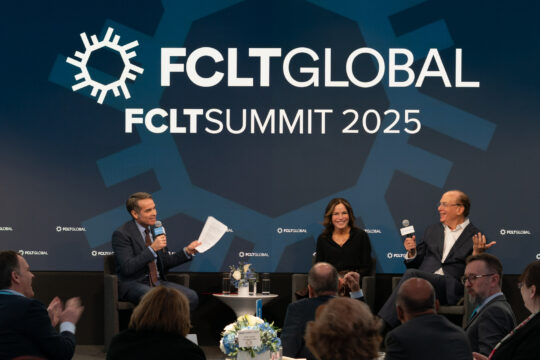
Risk and Resilience, Stakeholder Capitalism | Report
6 March 2025 - At FCLT Summit 2025, business and investment leaders developed practical solutions for creating long-term value amid unprecedented structural shifts in global capital markets.

Innovation | Article
27 January 2025 - On 21 January, FCLTGlobal convened its annual Davos CEO Roundtable for leaders from across industries to discuss how Europe has real opportunities for appreciation if policymakers can unleash its strengths.
Risk and Resilience | Report
26 February 2025 - The FCLTGlobal Blue Book, now in its third iteration, brings together perspectives from select members on how to put long-term strategies into practice today.