“In the long run, most of the time, values and value converge… it doesn’t matter much what your political perspective is… it will have an impact on the long-term cash flow potential of an asset.”
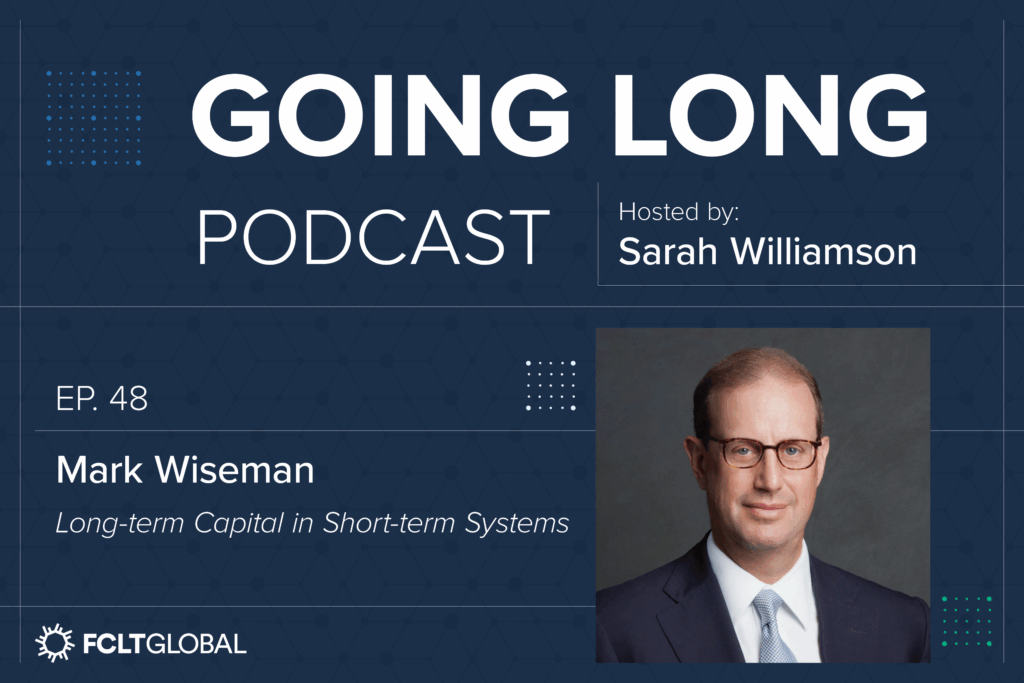
On this episode of the Going Long Podcast, Sarah Williamson welcomes Mark Wiseman, co-founder of FCLTGlobal and currently a Senior Advisor and Chairman of Lazard Canada. Wiseman unpacks why long-term capital is still up against short-term limitations, how private markets and geopolitical risk are reshaping portfolios, and what today’s investors must understand to build durable value in an increasingly unstable world.
Topics Include:
- [00:01:00] Why FCLTGlobal Was Created Almost a Decade Ago: How the global financial crisis triggered recognition that short-term market behavior was structurally misaligned with long-term savers.
- [00:02:30] The Core Mismatch Between Savers and Markets: Why individuals save for decades while institutional capital and corporate decisions operate on quarterly timeframes, and how this gap drives short-termism.
- [00:08:00] Private Markets: Long-Term Solution or New Risk? How private equity and infrastructure enable longer-term decision-making — and how liquidity innovations are starting to make private markets behave more like public ones.
- [00:21:00] Governance, Culture, and the Cost of Short-Term Thinking: The dangers of a “trading mentality” — and why long-term investing requires tolerance for underperformance.
- [00:33:40] Geopolitics, AI, and the Next Era of Investment Risk: Why geopolitical risk has become central to long-term investing, and how AI and critical resource scarcity could reshape value creation over the next two decades.
When Long-Term Capital Lives Inside Short-Term Systems
In this episode of Going Long, Mark Wiseman explores one of the most persistent structural problems in global finance: investors may want to think in decades, but the systems managing their capital are engineered to respond in quarters. The result is not just volatility, but chronic misalignment — between savers, intermediaries, and corporate decision-makers — that distorts value creation over time.
Wiseman argues that this mismatch was exposed most clearly by the global financial crisis and remains only partially addressed today. While long-term thinking is now more accepted in principle, the underlying market infrastructure still rewards speed, liquidity, and immediate performance. Incremental progress — such as reduced quarterly guidance and evolving manager mandates — has occurred within a world that has become more fragmented, more transactional, and more reactive.
The Limits of Structure, and the Power of Incentives
A central theme is that structure alone cannot solve short-termism. Large pension and sovereign wealth funds now have the size, data, and governance capacity to act as long-term stabilizers, yet even these institutions face powerful internal and external pressures. Contractual terms with asset managers, performance measurement frameworks, and individual compensation systems continue to pull behavior toward shorter horizons.
Wiseman cautions that without rethinking incentives — not just mandates — organizations risk replicating the very market behavior they were designed to counter. True long-termism, he suggests, requires accepting periods of underperformance and educating stakeholders to measure success over full market cycles rather than interim volatility.
Wiseman and Williamson also assess whether private markets represent a durable solution to short-term pressure. He notes that private equity, infrastructure, and private credit structures allow management teams to make decisions insulated from daily public market pricing. This insulation has enabled more deliberate capital allocation and governance in many cases.
However, the rapid evolution of liquidity tools — from secondary markets to tokenization and continuation vehicles — is beginning to shrink the behavioral gap between public and private markets. As access and pricing become more frequent, the long-term advantages of private structures increasingly depend on governance discipline rather than structural design alone.
A More Fragile World, a More Demanding Mandate
Looking forward, Wiseman identifies geopolitical risk as one of the most structurally underpriced variables in modern portfolios. Capital controls, sanctions, supply chain realignments, and shifting alliances are now recurrent features of global investing. Long-term capital, he argues, must now sit alongside political analysis, not just financial forecasting.
At the same time, advances in artificial intelligence, healthcare innovation, and the growing scarcity of critical materials point toward new long-duration value creation — provided investors are willing to look beyond short-term noise and hold through uncertainty. This episode reframes long-term investing not as a philosophical preference, but as a structural necessity in a world where risk no longer respects quarterly boundaries.